From July 2026, Vietnam introduces two new long-stay visa categories for skilled professionals and their families. The headlines have been generous with the enthusiasm. I’ve read between the lines and here’s the honest version.

Vietnam has been quietly rewriting its immigration story – and for those considering a longer stay, the latest chapter is worth reading carefully.
Vietnam has never been short on ambition. Over the past few years, it has expanded e-visa access to all nationalities, introduced 90-day multiple-entry stays, floated proposals for five-year talent exemptions, and consistently talked up its credentials as a destination for long-term visitors. Some of it was delivered. Some of it, if you followed the coverage in 2025, turned out to be considerably more limited in practice than the headlines suggested.
So when Vietnam announced two new visa categories – the UD1 for high-quality professionals and the UD2 for their accompanying families – launching on 1 July 2026, the reaction was predictably enthusiastic. And in fairness, it should be. These are genuine, legislated visas on a confirmed timeline. Vietnam is following through, which is itself worth noting. The question is whether they apply to you – and the honest answer, for the majority of people weighing up Vietnam as a long-term base, is probably not yet.
That caveat matters. But so does the bigger picture. Vietnam is moving in the right direction, faster than most of its neighbours would like to admit. It’s moniker as the most progressive nation in the region has to be earned.
The UD1 and UD2: What They Are
The UD1 visa is designed for what Vietnam officially calls high-quality talent – professionals working in digital technology, experts and senior researchers, key investors, and managers at organisations headquartered within Vietnam’s International Financial Centre (IFC) in Ho Chi Minh City. The UD2 covers the spouses and dependent children under 18 of UD1 holders, carrying the same duration and entry terms. Both visas are valid for up to five years with multiple-entry access, and the application process is capped at three working days once approved – a remarkable commitment from a country whose immigration processing has historically been considerably more leisurely.
For professionals specifically working within the IFC framework, the terms are even more generous. Eligible nationals – key investors, experts, scientists, and senior managers employed by IFC-registered organisations – can receive a UD1 temporary residence card valid for up to ten years. Priority immigration clearance and dedicated airport lanes are being established at Ho Chi Minh City and Da Nang for IFC personnel. There is also a pathway to permanent residency for qualifying investors and scientists, with a two-month processing commitment.
These are serious changes. Vietnam is not just creating a visa category on paper – it is building the infrastructure to make it work.
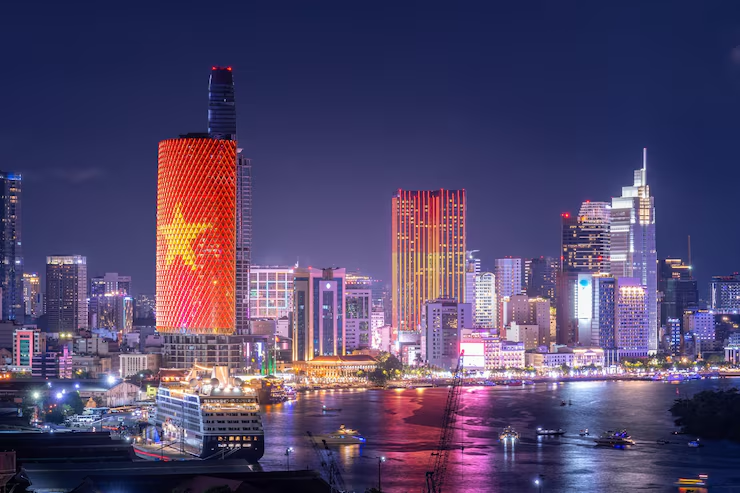
Ho Chi Minh City’s International Financial Centre is the engine behind the new visa framework – and the clearest signal of where Vietnam’s ambitions are pointed.
Who Qualifies – and Who Doesn’t
This is the part that gets lost in most of the coverage, so it’s worth being clear. The UD1 is not a digital nomad visa. It is not aimed at remote workers, freelancers, or self-employed professionals earning income from overseas clients. It targets a specific and relatively narrow group – doctoral-level researchers, senior corporate executives at IFC-registered firms, technology specialists in approved sectors, and significant investors. If your work life involves a laptop, a coffee shop, and a foreign employer who doesn’t particularly care where you are, the UD1 was not written with you in mind.
For the overwhelming majority of long-stay travellers and location-independent professionals, the 90-day multiple-entry e-visa at $50 USD remains the practical answer. It’s available to all nationalities, straightforward to apply for through Vietnam’s official portal, and covers most long-stay scenarios. Vietnam is also expanding e-visa acceptance to 83 border gates in 2026, including the new Long Thanh Airport – quietly making itself one of the most physically accessible countries in Southeast Asia.
There is also an existing investor visa – the DT category – already in operation for those with capital to deploy. It runs on a tiered system, with visa durations ranging from one to five years depending on investment level. The lowest tier requires around $115,000 USD; the five-year tier starts at $3.8 million USD. A separate ten-year investor visa has been discussed publicly, but as of April 2026 it has no confirmed launch date and is unlikely to materialise before 2027.
Being straight about this is not pessimism – it’s respect for your time. Vietnam is worth planning around. It’s just worth planning around what is actually available, not what the headlines suggest might be coming.

The e-visa remains the realistic long-stay option for most remote workers – but Vietnam’s direction of travel suggests that could change.
Why This Still Matters Even If You Don’t Qualify
The UD1 and UD2 are not the whole story but they are the most visible part of a broader shift in how Vietnam is positioning itself. When we covered the five-year talent exemption proposal in August 2025, it was still a draft decree – promising language, uncertain timeline, familiar caution. The UD1 and UD2 are different. They are in law. They have a launch date. Vietnam is demonstrating, in a way it hasn’t always managed, that it can put words into action.
That matters because it tells you something about Vietnam’s vision. A country that is expanding border access, confirming long-stay frameworks for skilled residents, investing in IFC infrastructure, and consistently recording double-digit tourism growth is a country that is getting more serious about welcoming people who want to stay. The gap between Vietnam’s current offer and a genuinely competitive long-stay option for nomadic professionals is real – but it is narrowing. Give it two or three years.
In the meantime, 90 days at a time is a genuinely good way to get to know a country that rewards patience. Vietnam’s affordability, its food, its geography – three thousand kilometres of coastline, highlands, ancient towns, river delta – and the warmth of the people make the visa run arithmetic considerably easier to justify than it would be almost anywhere else in the region.
How Vietnam Compares to Its Neighbours
It’s worth understanding what Vietnam is up against, because the region’s visa competition is more intense than it has ever been. Thailand’s Destination Thailand Visa offers five years of multiple-entry access for remote workers with a minimum bank balance of 500,000 THB – roughly £11,000 or $14,000 – no employer verification required and no sector restriction. Malaysia’s DE Rantau pass is open to technology professionals earning from $24,000 USD annually and offers up to three years’ stay. Indonesia’s E33G remote worker visa covers employees of foreign companies for up to two years.
Against that competition, Vietnam’s current middle ground – excellent e-visa access, a strong talent visa for a narrow professional category, and no clear offer for the broader remote working community – is a gap that its neighbours are actively exploiting. Thailand, in particular, has made a concerted pitch for exactly the audience Vietnam is not yet catering for.
Vietnam knows this. The UD1 and UD2 are not the final word. They are a sign that Vietnam is thinking seriously about what comes next. Whether it moves quickly enough to capture that audience before Thailand and Malaysia cement their positions will be one of the more interesting visa policy stories in the region over the next few years.

Vietnam’s geography alone makes the visa-run arithmetic worth doing – there are few places in the world that reward a longer stay as generously.
What to Do If You’re Planning a Long Stay in Vietnam
For most travellers, the practical path is clear. Apply for the 90-day multiple-entry e-visa through Vietnam’s official portal at evisa.gov.vn. Single entry costs $25 USD; multiple entry is $50 USD and is almost always the better option if you’re staying for any length of time. The application is entirely online and straightforward – there is no need for an agent or an intermediary.
If you need to extend your stay beyond 90 days, a border run to Cambodia or Laos is the common solution and is broadly tolerated, though it sits in a legal grey zone that Vietnam has not formally resolved. It works in practice. It is not, technically, the endorsed route.
If you believe you qualify for the UD1 – senior executive, specialist investor, researcher, or technology professional working within an IFC-registered organisation – the application pathway runs through the IFC’s governing authority rather than standard immigration channels. KPMG Vietnam’s February 2026 guidance is currently the most reliable publicly available summary of requirements. Verify everything directly with a qualified Vietnamese immigration specialist before committing.
And if you are an investor considering the DT category, the investment thresholds and approved categories should be confirmed with a Vietnamese legal firm before you make any decisions. The tiers have been adjusted before and the fine print matters.
The Bottom Line
Vietnam’s new visa categories are a genuine step forward. Not a revolution – but a step, taken on a confirmed timeline, by a government that is getting better at following through on its immigration promises. The UD1 and UD2 confirm that Vietnam is serious about attracting skilled talent and long-term professional residents. The e-visa framework already makes it one of the most accessible countries in Southeast Asia for everyone else.
What Vietnam still lacks is the clean, affordable, broad-access long-stay option that its neighbours are offering to mobile professionals. That gap will not close overnight. But the direction is right, the momentum is building, and Vietnam has one considerable advantage over its competitors – it is simply a more interesting country to spend time in than most places prepared to compete for your presence.
For more on Vietnam’s evolving travel landscape, read our coverage of Vietnam’s national tourism data platform and what the country’s 2025 provincial restructuring means for travellers.
Follow Asia Unmasked on Facebook and X/Twitter for the latest visa updates and long-stay guides across Southeast Asia.
#VietnamVisa #UD1Visa #LongStayVietnam #VietnamExpat #SoutheastAsiaVisa #RemoteWorkAsia #AsiaUnmasked #VietnamTravel #ConsciousTravel #SlowTravel