Issue No. 6 | Thursday 30 April 2026
Your insider guide to Southeast Asia
Your Week in Southeast Asia
This week we’ve covered developments across the region, including a resort on Palawan Island that has received a full eco-luxury make-over, which bodes well for the future of The Philippines – a country that has traditionally struggled for sustainable and eco-friendly options. A disturbing study coming out of Cambodia shows a near-total collapse of a secretive forest cat in a sanctuary that was supposed to be its stronghold. Meanwhile, Con Dao’s pristine reefs are now far easier to reach than they have ever been, we only hope that this area remains protected from over-tourism.
Cambodia is currently bearing the brunt of the mess created in the Gulf, with flights cancelled or rerouted. Elsewhere, Bali, which has been on the receiving end of some sharp criticism for its poor environmental record, has formally declared it is done chasing arrival numbers. In a bid to clean up it’s act, Bali is aiming for a big reset in how it manages tourism. This could lead to the island shunning its party image in a bid to repackage itself for wellness, spirituality and premium long-stayers. Whether this will change anything remains to be seen.
Palawan’s Most Celebrated Eco-Resort Just Got Smaller – and Better for It
Lagen Island Resort in El Nido, Palawan has quietly reopened after a landmark renovation – and its most telling decision was to remove eight rooms. Where 50 water villas and forest rooms once stood, there are now 42, with the reclaimed footprint handed back to the island’s forest floor and beachfront. Design firm WATG led the transformation under what it calls a preservation-first philosophy, retaining most of the original structures to protect biodiversity rather than demolishing and rebuilding.

The water villas now look out over the lagoon through staggered window openings – designed to maximise the view while minimising intrusion on the forest beyond.
The result weaves indigenous Palawan craft – handcarved wood, Sawali-patterned ceramics, terracotta pottery from the island’s own traditions – into a resort that feels genuinely rooted in its place. A new Marine and Biodiversity Discovery Centre gives guests an introduction to the ecosystems surrounding the resort. The Nest spa sits on elevated pathways to protect the forest floor beneath. For travellers serious about responsible luxury in the Philippines, Lagen Island has always been a benchmark. This renovation raises it further. Full room details and booking information are available at El Nido Resorts.
Vietnam’s Best-Kept Secret Just Became Much Easier to Reach
Con Dao – a small archipelago off southern Vietnam, historically significant, ecologically precious, and until recently a logistical headache – has just gained daily direct flights from both Hanoi and Ho Chi Minh City. Low-cost carrier Vietjet launched double-daily services on both routes this week, turning what was once a two-flight slog into a straightforward hop.
The islands are largely protected, and the national park covering most of the archipelago is home to sea turtle nesting beaches, dugongs, and one of the few genuinely intact coral reef systems left in the South China Sea. Con Dao’s relative difficulty of access has been its greatest conservation asset – keeping visitor numbers low and the reefs intact. More connectivity means more eyes on those reefs, and it will be worth watching whether the national park authorities respond with stronger management. For now, if Con Dao has been on your list, this is the moment to go before the crowds find it.
Bali Is Done Chasing Numbers – Here Is What That Actually Means
In early April, Bali’s provincial government and Indonesia’s national tourism authorities put formal language to what many operators had sensed was coming: a “big tourism reset” that puts quality of visitor above volume. The island is targeting 6.63 million international arrivals this year – a deliberate ceiling rather than a floor – with a stated preference for high-value travellers: wellness retreats, spiritual experiences, and premium long-stay visitors. The tourist levy is being directed more explicitly toward conservation and heritage site maintenance.
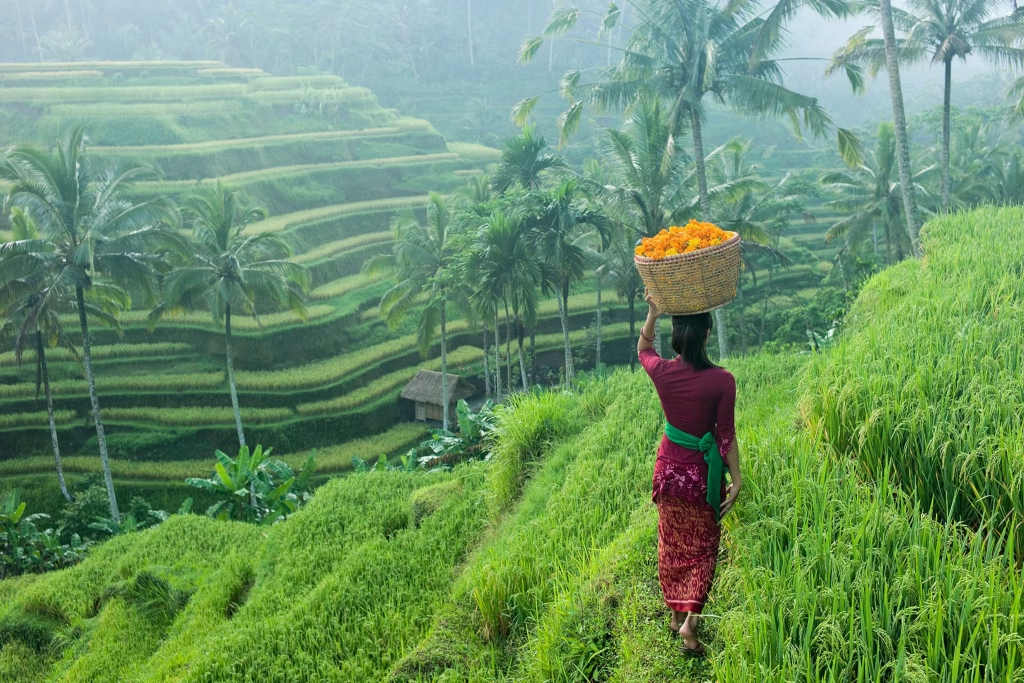
The reset is pushing visitors toward Bali’s quieter corners – and toward secondary destinations across the archipelago. Photo: National Geographic
Whether the rhetoric translates into genuine management on the ground remains to be seen. But secondary destinations across the archipelago are being actively promoted to ease Bali’s load – which is good news for travellers willing to look beyond the obvious.
Cambodia’s Tourism Operators Are Rerouting Fast as Gulf Links Fray
Cambodia is feeling the disruption of global aviation more acutely than most of its neighbours. With a direct-flight network thinner than Vietnam, Thailand, or Indonesia, the country relies heavily on Gulf hub transit for its European visitors – and those routes are taking a beating from ongoing Middle East tensions. TTG Asia reported this week that European travellers who once booked six months in advance are now committing eight to ten weeks out, waiting for news before locking in plans.
The practical response is a pivot to regional feeder markets. Cambodia is deepening ties with Vietnam – bus services between Phnom Penh and Ho Chi Minh City have jumped from six to fourteen daily – and a Phu Quoc to Kampot ferry is in development. For travellers already in Southeast Asia, overland Cambodia is more accessible than ever. The most immediate concern is for community-led tourism operations, where revenue dips hit social programmes directly and a school year cannot wait for European booking windows to stabilise.
A Rare Cambodian Forest Cat Is Disappearing from Its Last Stronghold
A decade of camera-trap data from Cambodia’s Srepok Wildlife Sanctuary has revealed a 75 to 95 per cent decline in the large-spotted civet – a secretive, slow-reproducing nocturnal carnivore that the sanctuary was considered a global stronghold for. The study, published this week in Pacific Conservation Biology, projects local extinction by 2034 if current trends continue.
The culprit is not targeted hunting but indiscriminate snaring, which increased significantly across the study period and hits slow-breeding species hardest. The large-spotted civet produces only two offspring per year; it cannot absorb the same mortality as its closely related cousin, the large Indian civet, whose population in the same sanctuary has actually grown. Researchers call for immediate community-based snare removal and wildlife-friendly incentive programmes for local residents – the same toolkit that has worked elsewhere in Southeast Asia. The pathways to change are known. What is needed is urgency and funding.
Thailand’s Tourist Levy Is Back – Now With Insurance Attached
Thailand’s long-running tourist fee saga entered a new chapter this month. The country’s sixth tourism minister since 2023 has confirmed the 300-baht (approximately £7.50/US$9) air-arrival levy is back on the table under the incoming Anutin administration – this time with a notable addition: a portion of the fee, reportedly 70 baht, will fund mandatory travel insurance for foreign visitors from the moment they enter the country. Plans to charge a separate fee for land and sea arrivals have been set aside for now.
The wider context is sobering. Second-quarter 2026 arrivals are projected to run 9.4 per cent below equivalent 2025 figures, and the minister himself has said restoring revenue to 2019 levels could take four years. No implementation date has been confirmed for the levy. The fee, if approved by Cabinet, would not apply to long-stay residents or holders of non-tourist visas. Full details of the proposed levy and its current status are covered in The Nation Thailand.
What’s On
This Week
Labour Day Long Weekend – Region-wide | 1-3 May 2026 Vietnam, Cambodia, Indonesia, and Thailand all observe International Labour Day on 1 May, with many extending it to a long weekend. Domestic tourism peaks across the region – worth building an itinerary around quieter secondary destinations if you’re travelling now.
Da Nang International Fireworks Festival – Da Nang, Vietnam | Opens early May 2026 The Han River lights up again for the annual international fireworks competition, running across multiple Saturday nights from early May through June. Street food, waterfront stages, and riverboat viewing add to the atmosphere. Confirmed competition dates and ticketing information are on the Da Nang Fantasticity website – check before booking travel.
Coming Up
Boun Bang Fai (Rocket Festival) – Laos & Northeast Thailand | Around 9-10 May 2026 One of mainland Southeast Asia’s most exhilarating celebrations, the Rocket Festival marks the start of the rainy season with homemade bamboo rockets launched into the sky to bring rain. Yasothon in northeast Thailand and communities throughout Laos host the main events. The rockets are genuinely enormous. Full dates and regional event listings are at the Tourism Authority of Thailand website.
Visakha Bucha Day – Thailand, Laos & Buddhist Southeast Asia | 31 May 2026 Buddhism’s most sacred day – commemorating the birth, enlightenment, and death of the Buddha – falls on 31 May this year. Candlelit processions circumnavigate temple ordination halls from dusk. Wat Phra That Doi Suthep in Chiang Mai and Wat Pho in Bangkok are particularly atmospheric. Alcohol sales are suspended nationwide in Thailand. Dress modestly and arrive at temples by 7pm. Full details of temple events and regional observances are listed on Thailand Now.
Worth Reading
With Con Dao’s coral reefs newly accessible and Lagen Island’s Marine and Biodiversity Discovery Centre opening its doors, this is a good week to think seriously about what lies beneath the surface in Southeast Asia.
Beneath the Surface: Exploring Southeast Asia’s Underwater Paradise
Follow Asia Unmasked on Facebook and X/Twitter