Three new UNESCO biosphere reserves landed in June, including a first for Timor-Leste. What the designation is actually betting on, and what it asks of anyone who visits.
Three places joined a very short list this June: UNESCO biosphere reserves, one of them a first for its country entirely. A biosphere reserve isn’t just a fancier name for a national park, and treating it as one misses what makes these three places genuinely interesting.
Here’s the model, in plain terms. A biosphere reserve runs on three zones rather than one big fence around a pretty view. A strictly protected core sits at the centre, closed to all but careful research. Around it, a buffer zone, where controlled, low-impact tourism is allowed on purpose, not as an oversight. Beyond that, a transition zone, where people just get on with farming, fishing and everyday life. The whole thing rests on a bet I happen to think is the right one: that conservation holds up better when the people living alongside a place actually have something to lose if it’s ruined, rather than being fenced out of land they’ve always used. In other words, they are genuine stakeholders. UNESCO isn’t just recognising scenery here. It’s backing a relationship between people and a place, and putting its name behind the idea that the two can coexist rather than compete.
That distinction matters more than it sounds, because tourism is exactly the kind of pressure these zones exist to manage. Get it wrong and you undo the very thing that earned the recognition, crowded wildlife, strained infrastructure, money that never reaches the people actually protecting the place. Get it right, permit caps respected, a local guide paid rather than skipped, a low-impact stay actually booked, and tourism becomes part of what keeps the balance working. I’d rather readers went into these three places with that in mind than treated them as three more names to tick off.
Vietnam, the Philippines and Timor-Leste each picked up a new designation this June. Here’s what each one is actually protecting, what visiting it properly looks like, and the practical detail you’ll need once you’ve decided it’s your kind of trip.
Vietnam: A Cave System That Funds Its Own Protection
Phong Nha-Ke Bang has held UNESCO World Heritage status since 2003, for a limestone karst landscape riddled with over 300 caves, Son Doong among them, the largest cave passage on Earth. What the new biosphere reserve badge adds is something the World Heritage listing never quite got round to: a formal nod to the guiding and portering economy built up around those caves, the people whose livelihoods the buffer zone is there to protect, not push out. It’s not complicated. The more a cave is worth to the community walking people through it, the harder that community fights to keep it intact.
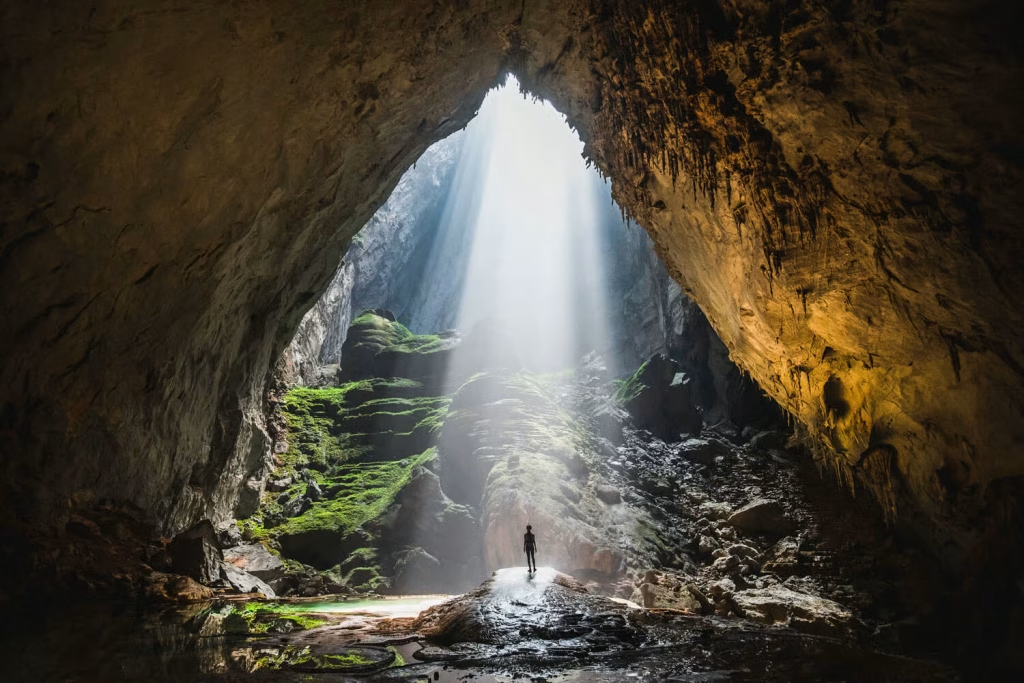
A permit cap and a single licensed operator have kept Son Doong’s cave ecosystem intact since it opened to visitors in 2014. Photo: Oxalis Adventure
Son Doong is the model doing exactly what it says on the tin. Access is capped at 1,000 permits a year, and every expedition runs through a single licensed operator, Oxalis Adventure, who employ local guides, porters and safety staff rather than flying in an outside crew and pocketing the difference. That’s precisely why the cave has stayed as pristine as it has since opening to tourists in 2014, and I’d rather see readers respect that cap than grumble about it. A four to five day expedition runs to roughly USD 3,000 per person, and slots for 2026 and 2027 are already gone. 2028 is the next window. If Son Doong is on your list, you’re planning years ahead, not booking a flight next month.
Not up for that kind of commitment, or budget? Fair enough. The same principle scales down neatly. Phong Nha Cave and Paradise Cave both take independent, ticketed visits, somewhere between 150,000 and 250,000 VND, roughly USD 6 to USD 10, without diminishing the wider park’s protected status one bit, since the boat and buggy routes are built to concentrate footfall exactly where the park can handle it. Dong Hoi Airport connects daily to Hanoi and Ho Chi Minh City, with a 45-minute transfer on to Phong Nha town. March to August is your window; go outside it and you’re gambling with closed routes.
If you’d rather the reserve’s philosophy showed up in where you sleep, not just where you hike, Auko Eco-Wellness Lodges opened along the Son River on 20 July, inside the reserve itself, built to bend with the landscape’s seasonal flooding rather than fight it. We covered the property when it was announced back in May, and again this week when it finally opened its doors.
Philippines: A Park Built Around Protecting One Animal
The Philippine reserve centres on Mounts Iglit-Baco Natural Park in Occidental Mindoro, 75,445 hectares that exist, essentially, because of one animal. The tamaraw, a dwarf buffalo found nowhere else on the planet, is now critically endangered and numbers in the low hundreds, and the park’s entire management style is built around keeping it that way. Rangers run monitored viewing zones rather than letting anyone wander in. Community patrols work the ground alongside official staff. And the Tau-Buid Mangyan people who live within the park’s boundaries are treated as part of protecting it, which strikes me as the only sensible way to run a place like this, rather than the more common approach of drawing a line on a map and hoping for the best.

Every guided visit to Mounts Iglit-Baco funds the community protecting the critically endangered tamaraw.
Visiting properly here means taking the park on its own terms, not finding a workaround. Every visitor needs a permit from the Tamaraw Conservation Program office, free for the basic viewing permit that gets you to the tamaraw viewing stations, with a modest extra fee if you want the trekking permit into the higher grasslands. A local guide isn’t optional, and I like that it isn’t: guiding fees, typically 500 pesos a day, go straight to the community actually managing the reserve rather than disappearing into some outside operator’s margin. Most trips run two or three days and cost roughly 4,000 to 5,500 pesos, around USD 70 to USD 100, all-in, permits, guiding, portering, basic ranger-station accommodation. That’s not a lot of money for what amounts to a direct contribution to keeping the tamaraw alive, rather than just an entry fee to look at one.
Getting there: San Jose airport in Occidental Mindoro, about an hour’s flight from Manila, or the longer overland route, ferry from Batangas to Abra de Ilog, then several hours by road. Once you’re there, facilities are properly basic, shared water sources, simple sleeping platforms, no mobile signal past the entrance towns. I wouldn’t call that a shortcoming. It’s the low-infrastructure model doing exactly what it’s meant to, keeping the reserve’s footprint small. If you’re after a polished visitor centre, look elsewhere. If you want a genuinely rationed wildlife encounter, one that hasn’t been dressed up for Instagram, this is it.
Timor-Leste: A Reserve Where Tourism Barely Exists Yet, By Design
Nino Konis Santana National Park, at Timor-Leste’s easternmost tip in Lautem Municipality, is the country’s first ever biosphere reserve, and honestly one of the newest of any kind, anywhere in the region. It runs to 1,236 square kilometres of forested mountain, savanna and reef, taking in Jaco Island, a small, sacred stretch of sand looked after by a single local family rather than anything resembling a visitor centre, and a slice of the Coral Triangle, which is about as biodiverse as ocean gets. The park is named after a commander of the independence resistance, born locally in Tutuala, and that’s not incidental. Its protection is tangled up with local identity in a way that feels earned rather than imposed from Geneva or wherever these things usually get decided.

Jaco Island’s marine zone sits within the Coral Triangle, cared for by a single local family rather than a visitor centre.
What sets this reserve apart from the other two is how little tourism infrastructure exists here at all, and I’d count that as a point in its favour, not against it. Timor-Leste has been calling itself Southeast Asia’s “last frontier” since its ASEAN accession earlier this year, and this park is where that stops being a marketing line and starts being simply true. Facilities are minimal. English gets patchy the moment you leave Dili. The community’s relationship with this land, ancient rock art, walled settlements, sacred limestone caves belonging to the Fataluku people, predates any UNESCO paperwork by centuries, and it shows. Visit properly and that means arriving with a booked local guide rather than winging it, asking before you photograph certain sites, and accepting genuinely basic conditions as the cost of somewhere that hasn’t yet been remodelled around visitors like you.
Access starts with a flight into Dili, usually via Bali or Darwin, then a drive or domestic hop on to Lospalos, the gateway town, and a final unpaved stretch to reach the park proper. Budget for real remoteness: daily costs for guides, transport and basic accommodation run roughly USD 25 to USD 65, though a private multi-day tour booked ahead, worth it given the roads and the patchy English, will cost more. Arrange it in advance. Don’t turn up and hope. May to October is the sensible window; roads that are merely rough in the dry season turn genuinely impassable once the rains arrive. For Jaco Island itself, boats leave from Valu Beach around 7am while the sea’s still calm. Bring cash for the small landing fee, and take everything you brought back out with you, since there’s no waste collection on the island whatsoever.
Three Countries, One Underlying Bet
What ties Phong Nha-Ke Bang, Mounts Iglit-Baco and Nino Konis Santana together isn’t just the timing of the announcement. It’s that all three are running the same bet, that a landscape survives better when the people living in it have something real to lose if it doesn’t, just caught at different stages of proving it out. Vietnam’s reserve shows the model fully grown: a cave economy funding the very community guiding people through it, a cap system that’s kept Son Doong genuinely pristine for over a decade rather than loved to death. The Philippines’ shows it built around saving one animal, where a guide’s daily wage is about as direct a line to conservation funding as you’ll find anywhere. Timor-Leste’s shows the model right at the start, tourism barely present yet, which is exactly why I think visiting it with care matters more here than almost anywhere else I’ve written about in this region.
None of these are places to turn up to passively, and I don’t think that’s a downside. All three ask something of you: respect a permit cap instead of resenting it, pay a local guide rather than skip one, accept that “undeveloped” is a form of protection rather than an inconvenience standing between you and a photo. That’s not a barrier to visiting. It’s the whole point of what UNESCO put its name behind this June, and it’s worth carrying that into how you plan the trip, not just where you book it.
For more on UNESCO-recognised destinations across Southeast Asia, read our coverage of Raja Ampat’s UNESCO status, or catch up on this week’s Unmasked Weekly for the wider regional picture, including Auko Eco-Wellness Lodges’ opening inside the Phong Nha-Ke Bang reserve. Follow Asia Unmasked on Facebook and Twitter/X for more.