Around the Region
Not everything that calls itself ethical always is. Operators and outlets across the region claim green credentials that don’t survive much scrutiny – and those of us seeking genuinely sustainable travel experiences know exactly what that looks like. The region is waking up to the reality that visitors don’t just want eco-friendly holidays; they’re prepared to invest real time and money in them. Where greenwashing occurs, it’s worth calling out. This week we look at Thailand’s elephant tourism industry, which has attempted to rebrand itself without meaningfully changing its conditions. Elsewhere the news is better – two genuinely good new openings in Vietnam on coastlines most visitors have never considered, and Sarawak’s Gawai festival this weekend, one of the most open-handed cultural celebrations in the region and about as far from manufactured tourism as it gets.
This Week in Southeast Asia
Vietnam’s Most Overlooked UNESCO Landscape Has a New Five-Star Base – and It Changes How You Visit
Ninh Binh has been on the Asia Unmasked radar for years – it has the karst scenery, the waterways, the ancient temples and the relative quiet that the more famous spots no longer offer. What it has lacked is a reliable base that matches the quality of the experience. That has now changed.

Trang An is a UNESCO World Heritage Site combining karst geology, ancient temples and working agricultural landscapes – and until now had no international hotel within its orbit.
Pullman Ninh Binh opened in late April as the first internationally branded hotel in the province. The 29-storey property sits above the city with unobstructed views of the Trang An Landscape Complex – a UNESCO World Heritage Site where visitors take bamboo rowing boats through cave-riddled karst and past thousand-year-old rice paddy systems. Hoa Lu, the 10th-century ancient capital of Vietnam, is 1.5 kilometres away. Trang An and Tam Coc, the two main visitor attractions, are ten kilometres out. The hotel brings five-star infrastructure – rooftop pool, spa, Champagne bar on the 27th floor, and 283 rooms with private balconies – to a destination that has been underserved since international tourism resumed. For anyone who has wanted to spend real time in Ninh Binh rather than rushing through on a day trip from Hanoi, this is the booking that makes it possible. Accor has committed to external sustainability certification across its entire portfolio by the end of 2026, with Green Key and LEED among the recognised standards being applied – and Ninh Binh province itself has been building an integrated eco-tourism and organic agriculture model that makes this a destination, not just a hotel.
A New Five-Star on the Vietnamese Coastline Most People Drive Past
Cam Ranh Bay sits between Da Nang and Ho Chi Minh City on Vietnam’s south-central coast – close enough to both that it should be a natural stop, but routinely skipped because there has been nowhere to stay that justifies the detour. The Melia Serenity Cam Ranh Beach Resort, which opened earlier this year on Long Beach, changes that calculation. Twenty-five pool villas, a private beach section, the Akoya Spa and four kilometres of relatively undeveloped coastline, with Cam Ranh International Airport under 20 minutes away.
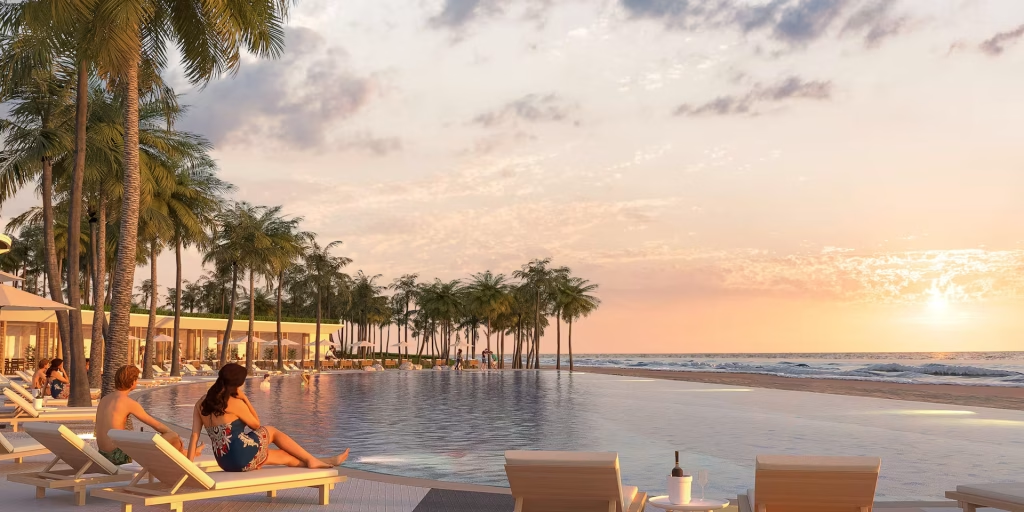
Cam Ranh Bay’s Long Beach remains one of Vietnam’s least-developed stretches of coastline – and now has a five-star property to match the setting. Image courtesy of melia hotels
Melia Hotels International brings more than a brand name to Cam Ranh. The group was named the most sustainable company in the global tourism sector by TIME magazine in 2024, holds Ecostars certification across more than 215 properties – recognised by the Global Sustainable Tourism Council – and is EarthCheck and Green Globe certified. Its Vietnamese properties run organic kitchen gardens and the group has committed to a 71% reduction in carbon emissions by 2035. For a stretch of coastline that has so far escaped the concrete sprawl of Phu Quoc and the over-development of parts of Da Nang, arriving with an operator that takes its environmental obligations seriously matters.
Sarawak’s Greatest Cultural Festival Opens Its Doors This Weekend – and It’s Worth Planning For.
Gawai Dayak begins on 1 June and it is, without exaggeration, one of the most generous festivals in Southeast Asia. Dayak communities across Sarawak mark the rice harvest with two days of open-house celebrations in which strangers are genuinely welcomed – not at a curated tourist performance, but into homes where tuak rice wine is pressed into your hand and traditional music carries on until the early hours. It is the kind of thing travel magazines describe but rarely manages to arrange for you. Kuching is the accessible base; longhouses sit in a crescent around the city and Sarawak Tourism Board runs a structured introduction programme for visitors wanting a guided welcome rather than arriving uninvited.
If Gawai is new to you, put it in the diary for next year – 1 June is the fixed date every year across Sarawak and Sabah, which makes it one of the easiest festivals in the region to plan around. If you are already in Sarawak this weekend, the celebrations are under way. Sarawak Tourism has everything you need to plan for next year.
For those already in peninsular Malaysia, Malaysia Airlines and Firefly have added capacity on routes to Kuching and Kota Kinabalu for the festive window. If you are making the journey specifically for Gawai, the more considered option is to extend the trip – Sarawak rewards time rather than a quick in-and-out, and combining Kuching with the rainforest interior, the Kinabatangan River, or Sepilok means the carbon cost of flying is carried across a genuinely immersive experience rather than a single weekend.
Thailand’s “Ethical” Elephant Experiences Are Being Rebranded – But the Conditions Haven’t Changed

Genuine observation-only sanctuaries allow elephants to move through their habitat with minimal human interference. The challenge for visitors is knowing which operations actually deliver this.
A major 15-year assessment of Thailand’s captive elephant tourism industry, published by World Animal Protection in January 2026, found that 69% of the 2,849 elephants held across 236 tourism venues are living in poor or unacceptable conditions. That figure is almost identical to the one recorded in 2019 – a period during which the industry has widely rebranded itself as ethical. The shift away from elephant riding has been real; the number of elephants forced to perform has declined. What has replaced it is the problem. Activities now marketed as “ethical alternatives” – elephant washing, bathing, caretaker-for-a-day programmes – require the same punishment-based training and constant restraint as the practices they replaced. The label changed. The conditions did not.
The report does name operations that have genuinely moved to observation-only models: Chang Chill and Following Giants were specifically supported by World Animal Protection to make the transition. Somboon Legacy Foundation in Kanchanaburi is independently recommended by welfare researchers. Phuket Elephant Sanctuary discontinued all feeding interactions as of 1 April 2026 – a positive step that improves its standing. The consistent test for any venue is whether it offers riding or any form of direct physical contact with visitors. If it does, the welfare practices required to make that possible have not changed regardless of the name on the sign.
What’s On
This Week
GAWAI DAYAK – Kuching and across Sarawak, Malaysia | 1-2 June 2026
The Dayak harvest festival, with open-house celebrations at longhouses throughout Sarawak. Kuching is the most accessible base for visitors. Sarawak Tourism Board’s cultural programme offers a structured introduction.
DA NANG INTERNATIONAL FIREWORKS FESTIVAL (DIFF 2026) – Da Nang, Vietnam | Running through 11 July (Saturdays, from 8pm)
Next competition night: 6 June – France vs Vietnam. Ten international teams compete above the Han River on the theme “United Horizons.”
Coming Up
BALI ARTS FESTIVAL (PESTA KESENIAN BALI) – Denpasar, Bali, Indonesia | 13 June – 11 July 2026
The 48th annual festival: 20,000 artists, 500-plus performances of traditional Balinese dance, gamelan, theatre, and crafts. Theme this year is “Atma Kerthi” – the purification and elevation of the soul. Most events are free. The opening day grand parade through Denpasar alone is worth planning a Bali trip around.
PHI TA KHON GHOST FESTIVAL – Dan Sai, Loei Province, Thailand | 20-22 June 2026
One of Thailand’s most visually distinctive regional festivals: ghost mask parades, merit-making ceremonies, and folk performances rooted in the legend of Prince Vessantara. Off the main tourist trail and worth the journey – a full day from Khon Kaen or an overnight from Bangkok.
Worth Reading
The elephant story this week is a case study in exactly what this guide covers – how “ethical” becomes a marketing term before it becomes a standard. Worth keeping bookmarked for every wildlife booking decision you make in the region.
Follow Asia Unmasked on Facebook | X/Twitter
#UnmaskedWeekly #AsiaUnmasked #SEATravel