A Few Words From Me
Anak Krakatau has form for making headlines it would rather not, though I’ll say this for it, this time it let the world’s rarest rhino off comparatively lightly. Ujung Kulon has now sat out two Krakatau eruptions unscathed, which either says something reassuring about that stretch of coast or something the region should stop relying on, and if I’m honest, I lean towards the latter. Not everything in Borneo went the same way this week. Nine orangutans pulled from burning plantations in under a month is the kind of story I wish this newsletter ran less often. Vietnam gave me the opposite feeling entirely, proof that paying people properly to look after a forest works about as well as you’d expect, a genuine 25 per cent income lift in the Annamite mountains for doing exactly that, and I’d happily read a hundred more stories built on that same unglamorous logic. Singapore, for its part, has settled on a fee rather than a crisis, which by the standards of this issue counts as the calm one. As always, tell me what I’ve missed, and let me know how things look from where you’re standing.
This Week in Southeast Asia
Vietnam’s Forest Corridors Are Paying Villagers to Keep Them Standing
Households living inside two biodiversity corridors in Vietnam’s Annamite mountains earn 25 per cent more than neighbours just outside them, according to a new study surveying 120 households across four villages in Quang Nam and Thua Thien Hue provinces. Income inside the corridors runs to roughly 412 US dollars per hectare per year, against 330 outside, and the difference comes almost entirely from Payment for Forest Environmental Services, Vietnam’s national scheme for watershed protection, alongside forest restoration and non-timber forest product work.
The corridors, established in 2018 along the border with Laos, link the Saola Nature Reserve, Song Thanh National Park and the Elephant Habitat and Species Conservation Area in Quang Nam, and a second stretch connecting the Saola and Phong Dien nature reserves further north. “By providing regular financial benefits from forest protection, programmes like PFES create incentives for communities to maintain forest cover and reduce pressures on critical habitats,” said Nguyen Van Tri Tin, a conservation scientist at Southern Cross University who worked on the study.
Song Thanh, Vietnam’s second-largest national park, sits within reach of Hoi An, and several of the same communities named in the study run community-based ecotourism villages offering homestays, guided treks and river trips. Anyone building conservation into a Vietnam itinerary can start by asking a Hoi An-based operator about a Quang Nam community stay, rather than treating the ancient town as the whole visit.

Community-run homestays near Hoi An give visitors a direct look at the forests and gardens these payments help protect.
Booking Flights Through Singapore? A New Green Fee Starts Next Year
Singapore’s Civil Aviation Authority has confirmed, in a statement issued this month, the final timing for its Sustainable Aviation Fuel levy: it applies to tickets and services sold from 1 October 2026, for flights departing Singapore from 1 January 2027. The scheme was first announced in November 2025 for an earlier start, then pushed back a year in March amid pressure from the Middle East conflict on fuel costs and airline finances.
The levy is smallest for the routes most Unmasked Weekly readers will actually fly. Economy passengers heading elsewhere in Southeast Asia pay just one Singapore dollar; the same class of ticket to Tokyo runs to 2.80 dollars, to London 6.40, and to New York 10.40. Business and first class pay four times those amounts. Cargo shipments get a further year’s grace, deferred to October 2027 for flights from January 2028. Every levy will show as its own line on the fare breakdown, alongside existing taxes and charges.
The practical point for anyone booking now: nothing changes for a ticket bought before 1 October 2026, whenever the flight departs, and nothing changes for travel before 1 January 2027, whenever it’s booked. Only a ticket sold from 1 October for a flight from 1 January 2027 onward carries the charge, so travellers with flexible dates around that window have a genuine reason to book early.
The World’s Rarest Rhino Just Survived Another Krakatau Eruption
Mount Anak Krakatau erupted on 4 September, its strongest activity since Indonesian authorities raised its alert status in July, closing Jakarta’s Soekarno-Hatta International Airport along with seven other airports and, at the peak of the disruption, stranding hundreds of thousands of passengers across the region. Indonesia issued emergency stay permits for foreign travellers caught up in the disruption, and flights have since resumed. Unlike the volcano’s 2018 eruption, which triggered a tsunami that killed more than 400 people, this one has not produced a wave.
That matters directly for Ujung Kulon National Park, just across the Sunda Strait from the volcano and the last place on Earth where the Javan rhino survives. The population was long put at around 76, until a poaching scandal uncovered in 2023 changed the picture: convicted poachers confessed to killing as many as 26 rhinos, close to a third of the total, between 2018 and 2023. Trials ran through 2025, ending in the longest wildlife-crime sentences Indonesia has handed down. The population is now believed to be closer to 50, though an exact count is genuinely difficult given how rarely the species is seen in dense rainforest. New calves keep arriving most years, a real if partial counterweight. The rhinos cluster along the park’s sheltered southern coast, which kept them safe from this eruption as it did in 2018, but with the population already reduced by poaching and confined to one park, conservationists warn a single bad eruption, disease outbreak or tsunami remains capable of finishing what the poachers started.
Visitors won’t see the rhinos themselves; they actively avoid people. But the park is open for jungle trekking, snorkelling and island-hopping around Peucang Island, reached by boat charter from Carita Beach or overland via Tamanjaya village, where entry permits and guides are arranged directly through the national park office. Given the current volcanic activity, check with the park office on access before booking a trip.
Nine Orangutans Rescued as Borneo’s Fire Season Turns Deadly
Wildfires driven by an intensifying dry season have swept across Ketapang Regency in West Kalimantan since early August, and conservation teams have rescued nine orangutans from the fire zone in under a month. Not all of them made it: one adult male, found weak in a community oil-palm plantation, later died of acute hypoxia and lung damage after days of smoke exposure. A mother and infant evacuated from Sungai Awan Kiri village on 5 September needed oxygen support for the infant’s breathing, while a family of three was successfully translocated in late August to Gunung Palung National Park, one of Borneo’s last strongholds for wild orangutans.
The rescues have been carried out jointly by West Kalimantan’s Natural Resources Conservation Agency and the International Animal Rescue Indonesia Foundation, known as YIARI, which runs the regional rehabilitation centre the animals are taken to. Smoke from the fires has since spread beyond Kalimantan into neighbouring Sarawak, and Indonesia has accepted firefighting equipment from Japan to help bring the fires under control.
Anyone with an orangutan-focused trip booked to Gunung Palung, typically reached via Ketapang town and the gateway village of Sukadana, should check current air-quality advisories and confirm access with their operator before travelling. YIARI accepts direct donations toward its rescue and rehabilitation work for readers who want to support the response without booking a trip.
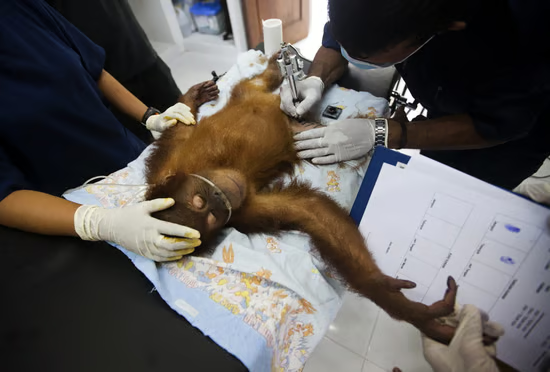
Rescue teams have treated several orangutans for smoke-related respiratory distress during Borneo’s fire season. Photo: World Animal Protection
What’s On
This Week
Bali International Airshow – Bali, Indonesia | 18–21 September 2026
Aerial displays and a static aircraft exhibition run alongside an aerospace trade event at Bali’s main airport, family-friendly and open to the public on selected days.
Dili International Film Festival – Dili, Timor-Leste | 24 September – 12 October 2026
Nearly three weeks of Timorese and international cinema across venues in the capital, with workshops and talks from emerging local filmmakers.
Johor International ASEAN Festival – Iskandar Puteri, Malaysia | 24–28 September 2026
Five days of food, crafts and performance from across all ten ASEAN nations at KRAMSAU, organised with Yayasan Warisan Johor.
Mid-Autumn Festival – Vietnam, Singapore and Malaysia (regional) | 25 September 2026
Lantern processions, mooncakes and family celebrations run across the region’s Chinese and Vietnamese communities, at their most visible in Hoi An and Singapore’s Chinatown.
Coming Up
Aileu Coffee Festival – Aileu, Timor-Leste | 27 September 2026
An easy day trip from Dili into the highlands for a celebration of Timor-Leste’s Arabica harvest, with a quality competition, barista competition, a 10K run and market stalls of local produce.
Worth Reading
Ketapang’s orangutan rescues are the sharp end of a bigger story about what wildlife tourism dollars actually fund in Borneo. This piece looks at the conservation economy behind the island’s protected areas, the same network the rescued animals in this issue’s story are being returned to.
facebook.com/asiaunmasked │ x.com/AsiaUnmasked │ asiaunmasked.com