Once Southeast Asia’s most captivating undiscovered destination, Myanmar is now one of its most contested. Here is what you need to know.
Asia Unmasked has not written about Myanmar until now. That is not an oversight. Since this publication launched, Myanmar has been a country at war with itself – a place where writing about travel without writing about the military coup, the airstrikes, the displaced millions, and the ethical weight of tourist spending would have been a disservice to readers and to the country’s people. This is not the article we wanted to write first about Myanmar. It is the article that needed to be written before any other.
To understand why that matters, you need to understand what Myanmar was, what it became, and what it means – starting with something as apparently simple as its name.

Bagan’s plains hold more than 2,200 surviving pagodas built between the 9th and 13th centuries – one of the most concentrated collections of Buddhist architecture on earth. The site drew visitors from across the world during Myanmar’s brief window of democratic opening between 2011 and 2021.
Burma, Myanmar, and What’s in a Name?
The country has two names and the choice between them is a political statement, whether you intend it to be or not.
Burma was the name used under British colonial rule, derived from the dominant Burman ethnic group. When the military junta seized power in 1989, it renamed the country Myanmar – a move widely interpreted as an assertion of military authority rather than a gesture of national reconciliation, since the change was made without democratic consent and without consultation with the country’s many ethnic minority groups. The opposition, led at the time by Aung San Suu Kyi and the National League for Democracy, rejected the new name for years as a refusal to legitimise the regime that imposed it. Many Western governments followed suit – the United States long used Burma in official communications as a deliberate political signal, a practice some outlets and organisations maintain today.
The situation has since blurred. The NLD eventually used both names interchangeably. The UK government now uses “Myanmar (Burma)” in its official travel advice. Most international organisations use Myanmar. This article uses Myanmar as the current widely adopted form, while noting that the naming dispute is itself a small window into the country’s larger history of contested power – between the military and the civilian population, between the dominant Burman majority and the country’s 135 recognised ethnic groups, and between the governments that ruled and the people they claimed to represent.
What Myanmar Was – and What Made It Extraordinary
For most of the twentieth century, Myanmar was closed. Decades of military dictatorship kept it largely sealed from the world – no independent press, heavily restricted foreign access, an economy built on jade mining, natural gas and a black market the junta both enabled and exploited. While Thailand, Vietnam and Cambodia opened to tourism and investment, Myanmar remained apart: isolated, largely unknown outside academic and activist circles, and possessed of a cultural and natural wealth that had been accumulating untouched for generations.
That began to change in 2011, when a nominally civilian government took office following managed elections, and accelerated dramatically in 2015 when Aung San Suu Kyi’s National League for Democracy won a landslide election and took power. The world took notice. Travel restrictions eased. Visas became obtainable. A handful of adventurous travellers became thousands, then hundreds of thousands. By 2019, Myanmar was welcoming approximately 4.4 million visitors annually, according to Myanmar’s Ministry of Labour, Immigration and Population – a 23 per cent increase on the previous year and a figure that would have seemed impossible a decade earlier.
What those visitors found was unlike almost anything else in Southeast Asia. Not because of the temples – though the temples were extraordinary – but because the country had been sealed long enough that the apparatus of mass tourism had not yet arrived. There were no full moon parties, no beach clubs, no streets lined with rooftop bars. There was instead a country of striking physical beauty, enormous cultural depth, and people of extraordinary warmth who were, in many cases, encountering Western visitors for the first time in their lifetimes.
Bagan, in the dry plains of central Myanmar, was – and remains – one of the most astonishing archaeological sites on earth. More than 2,200 Buddhist pagodas, temples and monasteries built between the 9th and 13th centuries spread across a plain that stretches to every horizon. Designated a UNESCO World Heritage Site in 2019, it drew comparisons with Angkor Wat in Cambodia, but at the height of the tourist window it was visited by a fraction of Angkor’s crowd and retained a sense of tran quillity that Angkor had long since lost. Watching the sun rise over Bagan from a temple platform, with hot air balloons drifting between pagodas and mist clearing from the Irrawaddy River below, was described by experienced travellers as among the most affecting experiences Southeast Asia offered.
Inle Lake, nestled in the highlands of Shan State, was something else again. A freshwater lake at 880 metres above sea level, home to the Intha people, whose leg-rowing fishing technique – standing on one leg at the stern of a narrow wooden boat, wrapping the other around the oar – is found nowhere else on earth. Floating gardens cultivated on the lake’s surface. Stilted villages connected by narrow waterways. A silk-weaving tradition using lotus fibre drawn from the stems of the flowers growing in the shallows. It was, by every account, a place that felt genuinely removed from the modern world without being a performance of itself.
Mandalay, the last royal capital of Burma before the British arrived, held the concentrated weight of a civilisation – the crafts of gold-leaf beating, marble sculpting and traditional marionette-making still practised in workshops that had been there for generations. The colonial architecture of Yangon, the former capital, told a different story: a city that had been the most prosperous in Southeast Asia under British rule and had since weathered occupation, independence, dictatorship and isolation without losing its particular character. The Shwedagon Pagoda, rising 99 metres above the city and covered in gold plate and thousands of diamonds, remains one of the most sacred Buddhist sites in the world.
Beyond the more documented destinations, Myanmar held rewards for travellers willing to go further. Chin State’s indigenous facial tattoo traditions – women whose faces were inked in patterns that identified their village and status, a practice that largely died out with their generation. The trekking routes between Kalaw and Inle Lake through hill tribe villages that had rarely encountered foreign visitors. The ancient walled city of Mrauk U in Rakhine State, a rival to Bagan in historical significance and a fraction of its footfall. The Mergui Archipelago in the south – 800 islands of largely unexplored coastline. Myanmar was a country that could absorb curious, respectful travellers almost indefinitely without running out of things to show them.
That window closed on 1 February 2021.

Inle Lake’s Intha people practice a leg-rowing fishing technique found nowhere else on earth. The lake’s floating village communities were among the hardest hit by the March 2025 earthquake, with entire sections submerged and nearly 3,000 homes damaged or destroyed.
What Happened
The military coup of 1 February 2021 ended Myanmar’s democratic experiment in a single morning. Aung San Suu Kyi, President Win Myint, and hundreds of elected officials were detained before dawn. The Tatmadaw – Myanmar’s military – declared a year-long state of emergency, which it has since extended repeatedly. Suu Kyi was held in prison for over five years before being transferred to house arrest on 30 April 2026, when the junta reduced her sentence as part of an amnesty linked to Vesak Day. She still faces a remaining sentence of more than thirteen years on charges that international observers have dismissed as politically motivated. The Diplomat described the house arrest move as “part of a well-worn script” – a gesture designed to rehabilitate the regime’s international image ahead of ASEAN re-engagement, not a meaningful step toward her freedom.
What followed the coup was not the suppression of protests and a return to tense stability. It was the beginning of a civil war. The population did not accept the coup. A Civil Disobedience Movement drew millions of civil servants, doctors, teachers and workers away from their posts. Armed resistance formed rapidly – the People’s Defence Forces, aligned with the National Unity Government formed by deposed elected officials, fighting alongside established ethnic armed organisations that had been in conflict with the Tatmadaw for decades. By 2024, resistance forces had made significant territorial gains. The military, losing ground it had held for generations, escalated.
The escalation has been documented in detail by Human Rights Watch, Fortify Rights, Amnesty International and the UN Human Rights Council. Airstrikes on civilian infrastructure – schools, hospitals, monasteries, displacement camps. Artillery bombardments of villages. The recruitment and use of child soldiers. Sexual violence used as a weapon of war. The deployment, from late 2025, of commercial paramotors and gyrocopters to bomb civilian gatherings. Fortify Rights documented twelve aerial attacks on civilian sites in Karenni State alone between June and September 2025. In 2025, the UN recorded that children were killed by military airstrikes at a higher rate than in any previous year since the coup.
According to the Assistance Association for Political Prisoners Burma (AAPP), more than 22,000 people remained in political detention as of mid-2026 – a figure that includes the period following the junta’s April 2026 amnesty announcements, which independent monitors confirmed released far fewer verified political prisoners than officially claimed. The UN Human Rights Office reports that at least 3.6 million people have been internally displaced. Over 15 million face acute food insecurity. According to the Lowy Institute, the kyat has lost 80 per cent of its value against the US dollar since the coup. The World Bank projected Myanmar’s GDP would contract in the 2025-2026 fiscal year – and that was before the earthquake.
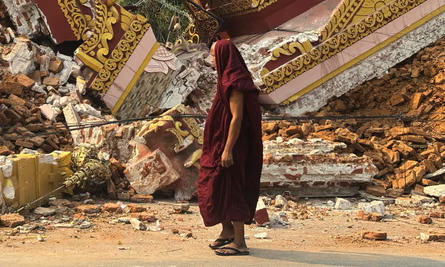
On 28 March 2025, a 7.7-magnitude earthquake struck central Myanmar near Sagaing and Mandalay. According to World Vision and the UN Office for the Coordination of Humanitarian Affairs, more than 3,600 people were confirmed dead, over 5,000 injured, and hundreds remained missing. More than 65,000 homes, 2,500 schools and 170 bridges were damaged or destroyed, along with over 6,000 pagodas and temples. The junta, despite announcing a ceasefire, carried out more than 550 aerial and artillery attacks in the two months that followed, hampering humanitarian access to people still recovering from the disaster. The UN confirmed that 6.3 million people needed assistance in the worst-affected areas.
This is not background context that can be read separately from the travel question. It is the travel question.
The Map Matters – But Only Up to a Point
Myanmar covers a territory roughly the size of France and the United Kingdom combined, and the conflict does not affect it uniformly. This matters for anyone making a travel decision – though it does not, on its own, resolve anything.
The UK’s Foreign, Commonwealth and Development Office – providing the most regionally specific of the major Western travel advisories – distinguishes between areas rather than applying a single blanket warning. Its current advice (updated January 2026, confirmed current as of June 2026) advises against all travel to Chin, Kachin, Kayah, Kayin, Mon and Rakhine states, Sagaing and Magway regions, most of Tanintharyi Region, northern Shan State, and north Mandalay Region. These are active conflict zones. Overland travel to and through them is not a matter of caution – it is a matter of genuine danger from airstrikes, artillery, landmines and armed confrontation.
The United States State Department and Australia’s DFAT apply their highest-level Do Not Travel designation to Myanmar as a whole. Both advisories are current. Both are based on the same documented conditions.
Within this picture, travel professionals and some security analysts refer to a “Tourist Kite” – four destinations that form a rough diamond across the country’s central heartland: Yangon in the south, Bagan to the west, Mandalay in the centre, and Inle Lake to the east. The FCDO does not advise against all travel to Yangon Region, though it notes that the security situation “remains volatile and can change at short notice,” that attacks targeting military locations “may affect civilians and bystanders, including in areas regularly frequented by foreign nationals,” and that hotels, restaurants and accommodation complexes are specifically named as locations at risk. Bagan and Inle Lake fall within areas where the FCDO advises against all but essential travel.
Multiple IED explosions occur monthly within the municipal Yangon area, according to US Embassy security assessments. The Yangon-Mandalay Expressway – the overland route between two of the four Tourist Kite destinations – has been targeted with landmines and IEDs. All operators with current ground presence strongly recommend flying between destinations rather than driving.
The earthquake added a specific layer of damage to two of the Tourist Kite locations. Inle Lake’s stilt villages were severely affected – entire sections submerged, nearly 3,000 homes damaged or destroyed, 90 deaths confirmed in surrounding villages, according to UN humanitarian reports. Tourism infrastructure at Inle Lake has reportedly recovered as of early 2026, but the communities are rebuilding from a position of compounded loss: conflict displacement, economic collapse, and a natural disaster the junta turned into a political one by continuing to bomb while people were recovering. Bagan’s World Heritage site was confirmed undamaged by satellite imagery assessed by UNOSAT post-earthquake – a rare piece of good news in an otherwise devastating picture.
Visitors who have travelled within the Tourist Kite in late 2025 and early 2026 report functioning hotels, domestic flights running between the four destinations, markets open, temples accessible. That is true. It is also true that those visitors move through conditions of ongoing conflict, active military operations, fragile infrastructure, and critically depleted healthcare – in a country whose regime will detain foreign nationals who draw attention to themselves in ways it finds inconvenient. Social media posts critical of the military, including private messages, have led to arrests. Myanmar’s Facebook and Twitter bans mean VPN use is widespread – and police have sought bribes from foreigners using VPNs even though they are not officially illegal.
The Tourist Kite is a real concept. It is not a safe zone. The distinction matters.

Daily life continues in Yangon, where markets and teashops remain open. The FCDO notes the security situation “remains volatile and can change at short notice” and that security incidents may affect civilians in areas frequented by foreign nationals.
The Money Question – and Why There Is No Clean Answer
This is the question most travellers ask and most travel writing fails to answer honestly. Does your money reach the people who need it, or does it reach the regime that is killing them?
The answer is: both. And there is no way to make it otherwise.
Every foreign visitor to Myanmar pays a $50 eVisa fee directly to the junta’s Ministry of Immigration. Entry fees at Bagan and Inle Lake – collected at military-administered checkpoints – go to the regime’s Directorate of Hotels and Tourism. Every business operating in Myanmar pays government taxes. Every vehicle on the road requires a government-issued licence. Every domestic airline remits money to the state. As Justice for Myanmar – a human rights organisation awarded the 2025 Right Livelihood Award for its documentation of the junta’s crimes – has stated explicitly: “Even if foreign visitors avoid hotels and transport owned by the Myanmar military and their associates, they will still fund the junta through visa fees, insurance and tax.”
That is not a fringe position. It is an accurate description of how Myanmar’s economy functions under military control.
The other side of this argument is also real. When visitor numbers collapsed after the coup, it was not the junta that bore the economic impact – it was guides with twenty years of experience who lost their livelihoods overnight, boatmen on Inle Lake whose children left school because there was no money for fees, guesthouse families whose savings were eaten away by inflation. The junta’s primary revenue streams – natural gas exports, rare earth mining, jade and precious stones – are the targets of Western sanctions, not tourism. Tourism is a secondary flow in the regime’s finances, and its collapse has fallen hardest on the people the regime is simultaneously brutalising. That argument has weight – but it does not cancel the first.
What this means in practice, if you decide to go, is that some of your spending will reach the regime and some will reach communities – and the proportion you can influence, though not eliminate, through the choices you make. Burmese-owned operators with documented community practice are a different proposition from regime-linked hotels. A family guesthouse is a different proposition from a state-affiliated property. A locally sourced meal in a teashop run by local people is a different proposition from a restaurant in a government-connected complex. None of these choices removes the unavoidable payments – the visa fee, the zone entry fees, the taxes embedded in every transaction – but they shift the balance of where discretionary spending lands.
Verification is the difficulty. No current independent source systematically lists which specific hotels or operators in the Tourist Kite have regime connections. Operators with Burmese ownership and documented community practices exist – some have maintained ground presence throughout the coup period – but assessing them requires research that goes well beyond a booking platform. Look for operators that are Burmese-owned, can demonstrate community benefit-sharing, fly you between destinations rather than driving through checkpoint-heavy roads, and are open about the ethical limits of what they offer. Responsible travel organisations and established independent Myanmar travel communities are more reliable for specific operator assessments than official tourism directories, which are regime-published.
One thing cannot be avoided regardless of how carefully you spend: the zone entry fees at Bagan and Inle Lake are paid at junta-administered collection points. There is no mechanism to visit these sites without this payment reaching the regime. That is a fact to sit with, not plan around.
Before You Decide
If you are genuinely considering visiting Myanmar, these are the questions worth working through before you book anything.
Can you accept that some of your money will reach the military regime? Not as an abstraction, but as a concrete reality – visa fees paid directly to the junta, zone entry fees collected at government checkpoints. If the answer is that you cannot accept this under any circumstances, the decision is made. A boycott grounded in that position is principled and understood.
Have you read the current FCDO advice for the specific regions you plan to visit – not the headline, but the regional risk detail? The FCDO’s breakdown is the most specific available and it changes. Check it immediately before you travel, not when you begin planning.
Do you have comprehensive travel insurance with medical evacuation cover? Healthcare infrastructure across Myanmar is critically depleted. The public sector health workforce has suffered severe shortages since the coup, with many medical staff joining the Civil Disobedience Movement. Medical supplies, including common prescription medicines, are not reliably available outside major cities. If you need emergency care outside Yangon, evacuation is the realistic option – and it is not guaranteed to be available.
Are you prepared to travel without the safety nets most international travel assumes? The US Embassy cannot reach all parts of the country. Consular services have been denied to detained foreigners in some cases. If something goes wrong outside the Tourist Kite, formal government assistance may not reach you.
Have you thought about your digital footprint? Social media posts, private messages and photographs that could be read as critical of the military have led to arrests, detention and deportation of foreign nationals. Erasing sensitive content from devices before entry is not paranoia in this context – it is the specific advice of the US State Department.
And finally: have you thought about what you will do with what you see? Visitors to Myanmar are, in a real sense, witnesses. The information environment inside the country is severely fragmented – internet shutdowns, journalist access restrictions, and a near-total news blackout mean that conditions in much of the country are not reaching people who need to know about them. Independent reporting from The Irrawaddy and Myanmar Now operates from exile. What travellers observe, document carefully, and share when they return has some value in keeping the situation visible. That is not a justification for going. It is a question about what going means.
What This Article Cannot Tell You
Conditions in Rakhine, Kachin, Kayah, Kayin and northern Shan States, and in Sagaing and Magway regions, cannot be reliably characterised from outside the country. These are active conflict zones where independent journalists have severely restricted access. The FCDO, Human Rights Watch, Fortify Rights and the UN all acknowledge the limits of their own visibility in these areas. This article does not describe conditions there, because it cannot do so accurately.
The precise proportion of tourist spending that flows to the regime versus to communities has not been quantified in any credible post-coup economic analysis. The directional arguments are well-sourced. The numbers are not.
The current status of specific community-based tourism operators, particularly around Inle Lake post-earthquake, is not independently verified in current sources. A framework of community-based tourism existed in Myanmar before the coup – formal government policy established in 2013, documented projects near Bagan, established trekking routes between Kalaw and Inle Lake with community ownership structures. Whether those survived the combination of coup, economic collapse and earthquake is not something this article can confirm.
Conditions in Mandalay specifically remain harder to assess than in Yangon or Bagan. The earthquake caused significant structural damage to the city. Conflict risk in the wider Mandalay Region is higher than in Yangon. The FCDO advises against all but essential travel to most of Mandalay Region. Visiting Mandalay in 2026 requires more current ground-level information than any single article can provide.
If you are seriously considering visiting, The Irrawaddy and Myanmar Now – both linked above – provide the most reliable current reporting on conditions inside the country. Read them before you make a decision, and read them as you plan.
The Honest Landing
Myanmar is not a destination you can visit without ethical cost right now. Nobody credible is arguing otherwise.
The case against going comes from documented fact: a military regime committing war crimes, a funding structure that makes some degree of financial contribution to that regime unavoidable for any visitor, and current government advisories from three major Western nations that reflect genuine and present risk. Justice for Myanmar’s call for a tourism boycott is principled, coherent, and based on direct expertise in how the junta’s economy functions. It deserves to be taken seriously.
The case for going – carefully, with full awareness of the above – also comes from documented fact. Communities that have lost half a decade of tourism income are not being protected by tourists staying away. The junta does not feel the economic pain of empty guesthouses and idle boatmen. The people who feel it are the same people the regime is brutalising. The people who feel it are the same communities whose livelihoods collapsed when tourism did. Whether that justifies going is not a factual question. It is a genuinely contested ethical one, and we will not pretend otherwise.
What can be said clearly: the FCDO’s regional breakdown is more useful than a single blanket position. Yangon is not the same situation as Sagaing. Bagan is not the same situation as Rakhine State. The regional picture is more nuanced than a blanket Do Not Travel position allows. If you go: fly between destinations, not overland. Use Burmese-owned operators with demonstrable community practice. Spend in local markets, teashops and family guesthouses. Erase sensitive digital content before entry. Carry medical evacuation insurance. Know what you cannot avoid funding, and make a conscious decision about whether you can live with that.
None of this makes visiting Myanmar an ethically comfortable decision. The most honest thing this article can offer is the information to make it with your eyes open – and the reminder that whatever you decide, the people of Myanmar are living with consequences far heavier than any travel choice.
For more on responsible travel across Southeast Asia, follow Asia Unmasked on Facebook and X.